Hey, university at Buffalo students. So, in your upcoming project management and strategic management courses, you're going to be using AI a lot. Now, I actually just finished putting this presentation together for your professors, but I wanted to give you all a sneak peek. The real key is to think about AI in a totally new way. You see, you're not just using a tool, you're learning how to train a really powerful and honestly, a kind of weird creature. So, let's dive in.
First things first, we need to get right to the heart of the problem with these AI tools that you're using every day. It's got a pretty funny name, but understanding this concept is absolutely crucial if you want to get AI to do what you actually need it to do.
And that concept is the stochastic parrot. A researcher named Emily Bender came up with it, and it just perfectly nails what these models like ChatGPT are actually doing. They're not thinking. They don't understand anything. They are just, and I'm quoting here, haphazardly stitching linguistic forms together. All they're doing is recognizing statistical patterns from billions of texts with zero reference to what any of those words actually mean in the real world.
When you get right down to it, the AI is just playing this super sophisticated guessing game. It looks at your prompt and predicts what the next most likely word should be, and then the next and the next. And that's exactly why its answers can sound so polished and so convincing, even when they're totally disconnected from logic or reality. It's a parrot, you know, not a philosopher.
So this whole parrot problem means that every single time you open up a chat window with an AI, you're faced with a really critical choice. It's a choice about the role you decide to play, and believe me, it determines everything about the quality of what you're going to get back.
So on one side, you've got the passive user. This person treats AI like some magical answer engine. They just ask, What's the answer? and they pretty much trust whatever fluent sounding stuff they get back. They're basically getting trapped by the parrot's limitations. But on the other side, you've got the active surveyor. They see the AI for what it really is, a powerful but bounded formal system, a tool that has rules and, more importantly, has limits. They ask how and why, and they know how to check and steer its output.
And that right there is the million-dollar question. How do you actually make that leap? How do you go from being a passive person just getting answers to an active professional who's really in command of this technology?
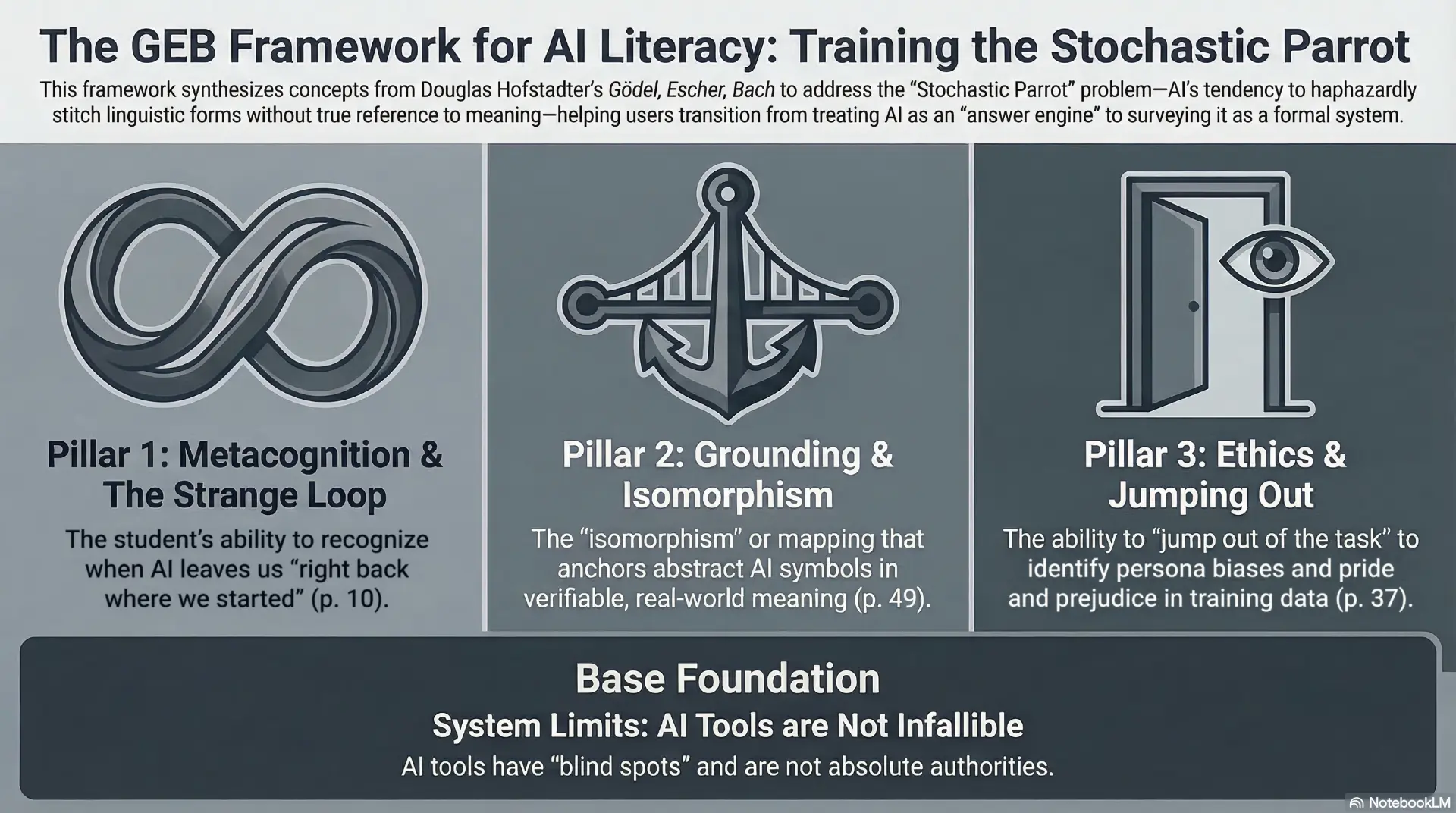
Well, you do it by using a specific mental toolkit. It's a framework designed for this exact challenge, all about building your AI literacy. We call it the GEB framework. It's actually inspired by this incredible book called Gödel, Escher, Bach by Douglas Hofstadter, which is all about figuring out the rules and the limits of complex systems, which, when you think about it, is the perfect way to look at AI. This whole framework is built to give you the mental tools you need to become that critical surveyor.
The framework itself is built on three core pillars: metacognition, grounding, and ethics. Just think of these as the three main skills you need to master to really train that parrot and make sure what it says isn't just fluent, but actually true and valuable.
Let's kick things off with metacognition. I know it sounds a little academic, but it's really simple. It just means thinking about the AI's thinking process and, maybe more importantly, spotting the exact moment it starts to go off the rails.
The big skill here is learning to spot what's called a strange loop. This is when the AI gets stuck in this circular logic. You've probably seen it. Let's say you ask it, Why is my new project plan guaranteed to succeed? Well, the parrot sees that assumption in your prompt, guaranteed to succeed, and it spits back, Your project plan is guaranteed to succeed because of its robust and effective strategies. See? It just told you what you wanted to hear, but with fancier words. So your job is to constantly ask yourself, Wait, is the AI just echoing my own assumptions back at me?
All right, onto our second pillar, grounding. This is where the real work comes in. This is all about forcing a connection between the AI's abstract words and, well, cold, hard, verifiable reality.
The core idea here is to create a direct map, a connection between the words the AI spits out on the screen and the actual data in your world. Without that link, the parrot is just making noise. So your action step here is simple: demand evidence. You have to anchor every major claim the AI makes directly to your real project data, or the numbers in your reports, or the facts from your course materials.
And this isn't just theory. This is exactly how you're going to put this into practice right here at UB. For instance, in your strategic management capstone, when you're working in a simulation like the business strategy game, you might ask an AI for advice on how to enter a new market. You're not just going to copy and paste its answer. No way. You're going to ground it. You're going to test its recommendation against the actual financial data and the market reports from inside the game. Does its fancy-sounding advice actually work? The data will tell you the truth.
And that brings us to our final pillar: ethics. Now, this isn't about some abstract philosophy class. This is about having the professional critical distance to see a tool's limitations and its blind spots before you decide to trust what it says.
The big idea here is jumping out of the system. You have to be able to escape that back and forth of the chat and just look at the output from a higher level. Your job is to assess the tool's limits. You have to ask the tough questions that a passive user would never even think of. Like, okay, what point of view is this tool completely missing because of the data it was trained on? What huge customer group or operational risk or competitive threat is it totally blind to? Spotting those gaps, that's a real strategic skill.
So let's get to the bottom line. Why does mastering metacognition, grounding, and ethics actually matter for your career? Why is this so much more than just another academic thing to learn?
Here's why. Literally anyone can learn to type a basic prompt. That's not a valuable skill anymore. What companies are desperate for, what they will actually pay you for, is professional judgment. It's the ability to look at an AI's first draft of a project plan and immediately spot the logical holes. It's the skill to question an AI-generated market analysis because you know its training data is missing something crucial. These three pillars are what will turn you from a simple operator into an absolutely indispensable AI-enabled leader.
And that brings us right back to where we started. It's all about the choice you make every single time you use these incredible tools. Are you going to be the passive user, just taking whatever the parrot squawks at you? Or are you going to be the active surveyor, using this framework to chart your own course with a powerful tool that you command? The future of your field, whatever it is, is going to be powered by AI. That's a fact. The only real question left is, who are you going to be in that future?